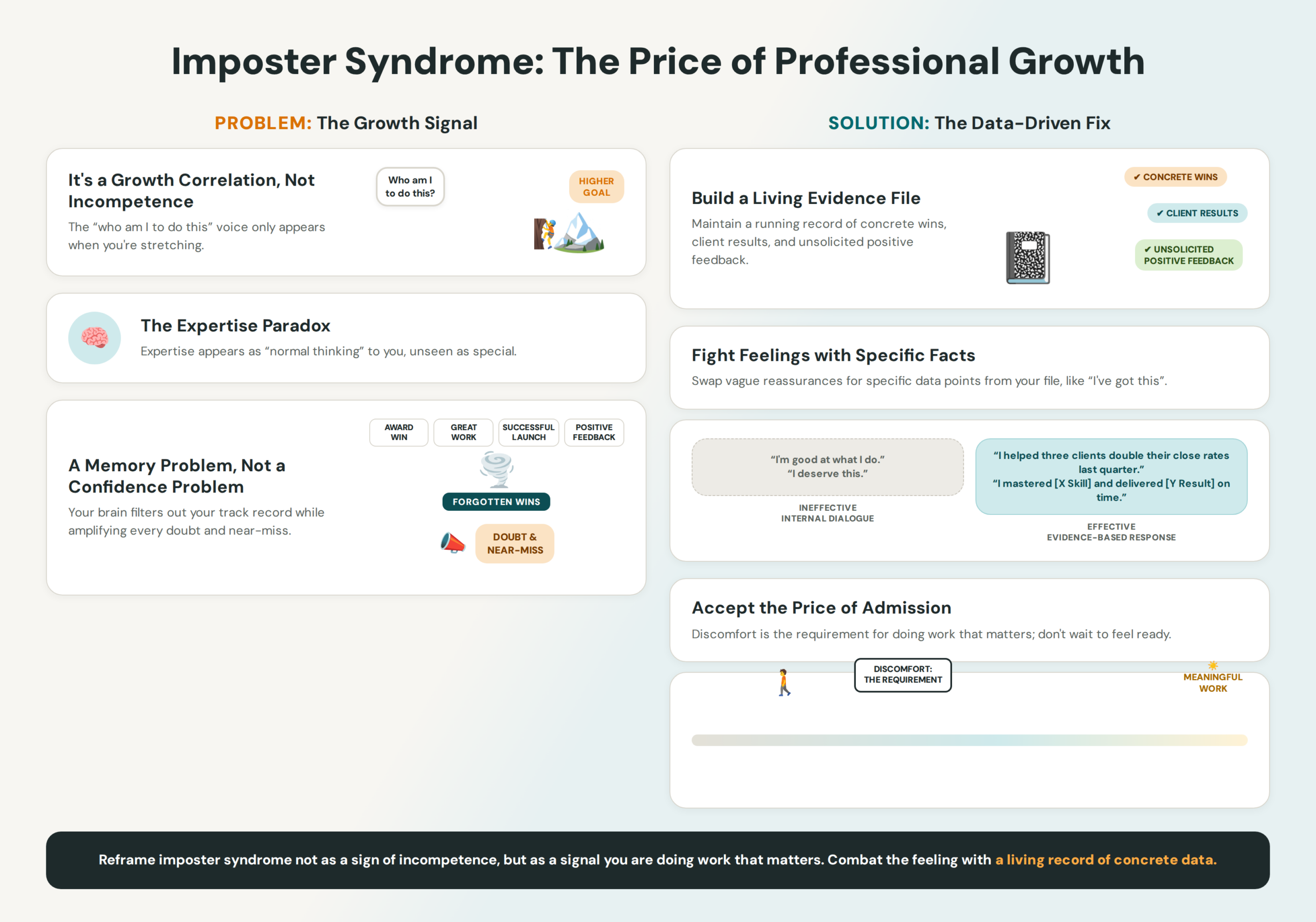
If you’ve felt like an imposter lately, here’s the first thing you need to know: that feeling doesn’t show up when you’re failing. It shows up when you’re doing something that matters.
Stepping into new territory — a bigger client, a new offer, a skill you’re still building — is exactly when the “who am I to do this” voice gets loud. That’s not a coincidence. It’s a pattern. The feeling correlates with growth, not incompetence. If you’re never uncomfortable, you’re probably not stretching. So the next time imposter syndrome hits, don’t treat it as evidence you don’t belong. Treat it as a signal you’re finally doing the work that scares you a little — which is usually the work worth doing.
Why It Won’t Go Away On Its Own
Here’s the part most advice gets wrong: you can’t think your way out of imposter syndrome with confidence or affirmations, because it isn’t a confidence problem. It’s a memory problem.
Your brain runs on selective memory. It filters out your actual track record and amplifies every doubt, every near-miss, every moment you weren’t sure. That’s why a pep talk doesn’t stick — you’re arguing with a feeling using vague reassurance, and vague reassurance loses every time to a brain that’s already decided to ignore the evidence in your favor. You don’t need more confidence. You need better data.
The Fix: Build an Evidence File
So build the data yourself. Keep a running record — call it an evidence file — of concrete wins, client results, and unsolicited positive feedback. Not a highlight reel you assemble once a year. A living document you add to the moment something good happens, before your brain has the chance to file it away and forget it.
Then use it correctly. When the doubt shows up, don’t respond with a vague reassurance like “I’ve got this.” Pull one specific fact from the file instead. Specificity is what disarms the feeling — it’s nearly impossible to argue with “I helped three clients double their close rate last quarter.” It’s very easy to argue with “I’m good at what I do.” Vague statements invite doubt. Specific evidence shuts it down.
The Uncomfortable Truth About Expertise
Here’s the part nobody tells you: expertise doesn’t feel like expertise from the inside. It just feels like normal thinking.
Whatever comes easily to you — the pattern you spot instantly, the advice you give without hesitating — feels ordinary because it’s yours. You assume everyone can see what you see, so you discount it. That’s precisely why the most experienced people are often the ones most likely to feel like frauds. The very depth of your expertise makes it invisible to you.
So stop waiting to feel like an expert before you act like one. That feeling isn’t coming, and it was never the requirement. The discomfort you’re carrying right now isn’t proof you don’t belong — it’s the price of admission for doing work that actually matters. Pay it, keep your evidence file current, and keep going anyway.
FAQs for the Article
Is imposter syndrome a sign that I’m not cut out for what I’m doing?
No — it’s usually the opposite. The feeling tends to show up precisely when you’re stretching into new territory, like a bigger client or a skill you’re still building, not when you’re failing. Treat it as a signal you’re doing work that matters rather than proof you don’t belong.
Why doesn’t positive self-talk or confidence-boosting actually get rid of imposter syndrome?
Because it isn’t a confidence problem — it’s a memory problem. Your brain selectively filters out your actual track record while amplifying every doubt and near-miss, so a vague pep talk has nothing solid to stand on and loses every time to that filtered memory.
What’s a practical way to fight imposter syndrome when it shows up in the moment?
Keep a running “evidence file” of concrete wins, client results, and unsolicited positive feedback, and pull a specific fact from it instead of reaching for vague reassurance. A statement like “I helped three clients double their close rate last quarter” is far harder to argue with than “I’m good at what I do,” because specificity disarms doubt while vague statements invite it.