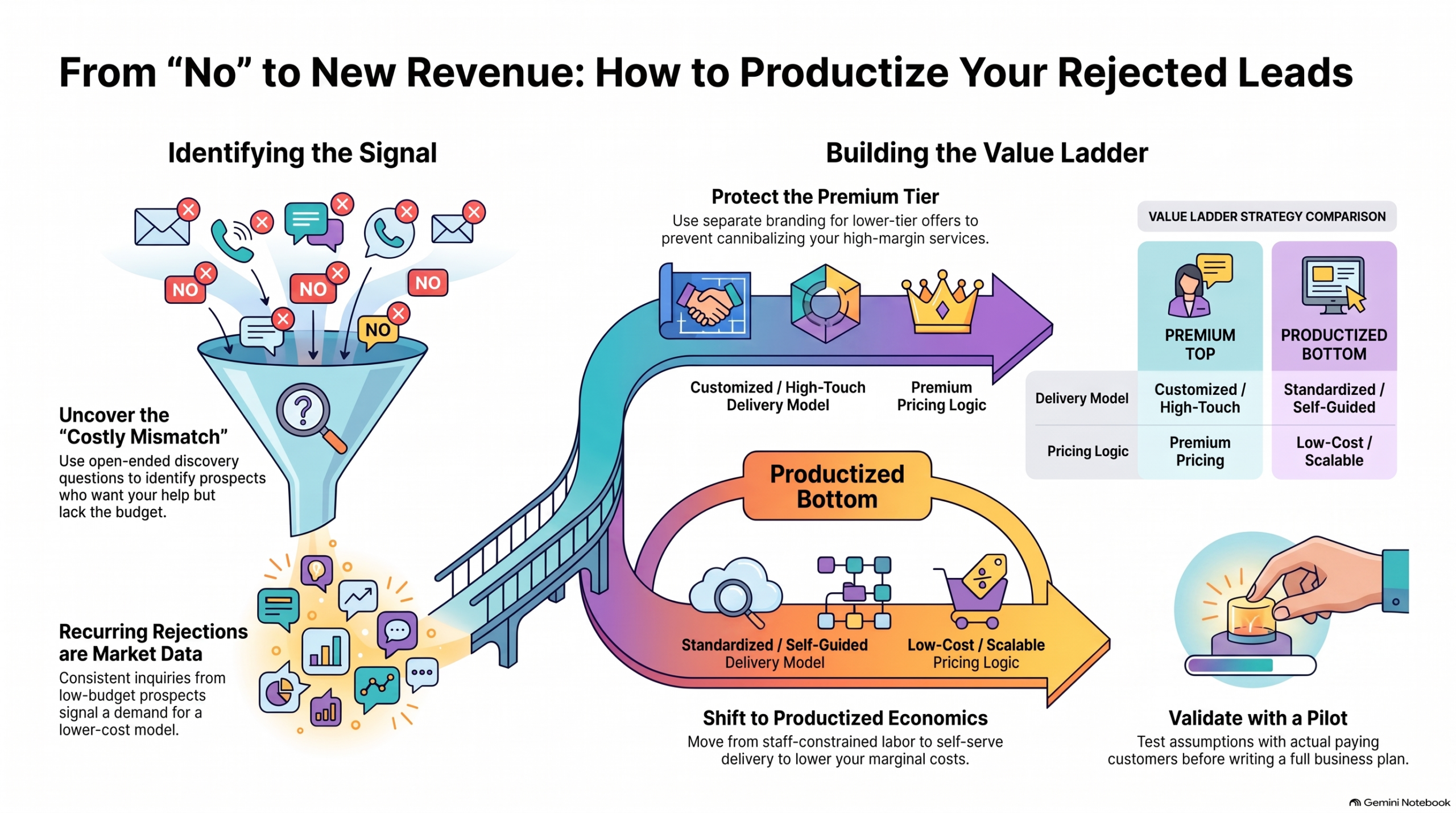
1. The overlooked signal in rejected leads
Is your next market opportunity hidden in the rejected, under-budget clientele? As a solo entrepreneur or small business owner, it’s important to understand your cost of doing business to ensure you don’t take on paying clients who cost you more than you make. If you’re consistently getting prospective clients who can’t afford your service, that recurring inquiry reveals a market gap you may not have anticipated. If you’re receiving similar requests every week or having difficulty finding clientele who can afford your service, it may be a signal that it’s time to pivot the business toward a more profitable and lower-cost model where demand might be higher.
2. Don’t discount—redesign the delivery model
If your business is a service business, discounting your service price destroys your profit margins. The important distinction is differentiating customer value from expensive customized delivery, and taking the time to identify which elements can be standardized or automated.
3. Build a value ladder
I invite you to picture your marketplace as a ladder. At the bottom, low‑cost providers scramble for scraps in a crowded space. At the top, premium‑priced, customized services cater to discerning clients whose needs cannot be met with a standardized offering.
If you create a do‑it‑yourself or self‑guided product, you can sell it at a lower price. In essence, you’ll have separate offers for prospects with different willingness to pay or budgets.
Decades ago I met a well‑known photographer who charged a high premium. He introduced me to the ladder metaphor because his services were in demand, yet only a small portion of his clientele could afford them. He opened a lower‑cost wedding photography studio across the street and referred business to it, allowing him to earn a modest profit from his partner’s work.
4. Technology is not necessarily the moat
Apps are becoming easier and cheaper to build, and generic content is readily copied. Therefore, the only true defensible advantages for service-based businesses are:
- firsthand knowledge
- curation
- brand trust
- customer insight(s)
- distribution and reach.
5. Productization changes the economics
Productizing your business changes the economics: you shift from staff‑constrained capacity to self‑serve delivery, lowering the marginal cost for each additional group or market and reusing content modules without delivering identical experiences. This turns your internal expertise into intellectual property.
6. Segmentation matters more than features
Understanding your market and its needs is more important than developing specific features for a product, service, or application.
Remember that the buyer is not always the end user. In many cases, the assistant to the CEO or COO might be your contact, someone seeking information but lacking a full understanding of the business or their needs. Education, patience and open ended questions therefore, is key.
Knowing your clients’ needs, wants, emotions, and perceptions provides a competitive advantage, allowing you to differentiate and address each market segment.
Use open‑ended questions during the discovery process to uncover costly mismatches and to identify companies that want your services but lack the budget to afford them. These prospects represent demand for a different product category that might represent an opportunity for your business.
7. Protect the premium business
When creating multiple pricing tiers, define clearly what the service includes and what it excludes. Use separate positioning and branding to minimize customer confusion, avoid internal price competition, and create a clear upgrade path. Otherwise, you miss the opportunity and risk cannibalizing your higher‑margin product tier.
Avoid decision fatigue by keeping choices simple, so customers don’t have to struggle to solve their problem.
8. Validate before writing a full business plan
Before investing too much time and energy in a full business plan, test your assumptions with actual paying customers.
For example, if you’re turning away clients because of an inadequate budget, run a pilot using an app or a productized version of your service. In the pilot, assess willingness to pay, completion rates, satisfaction, support needs, and gather reviews, while also researching competing products.
Conclusion
Every repeated “no” may contain a product specification.
The opportunity appears when a company stops treating rejected customers as unsuitable and starts asking whether they could be served through a different economic model.