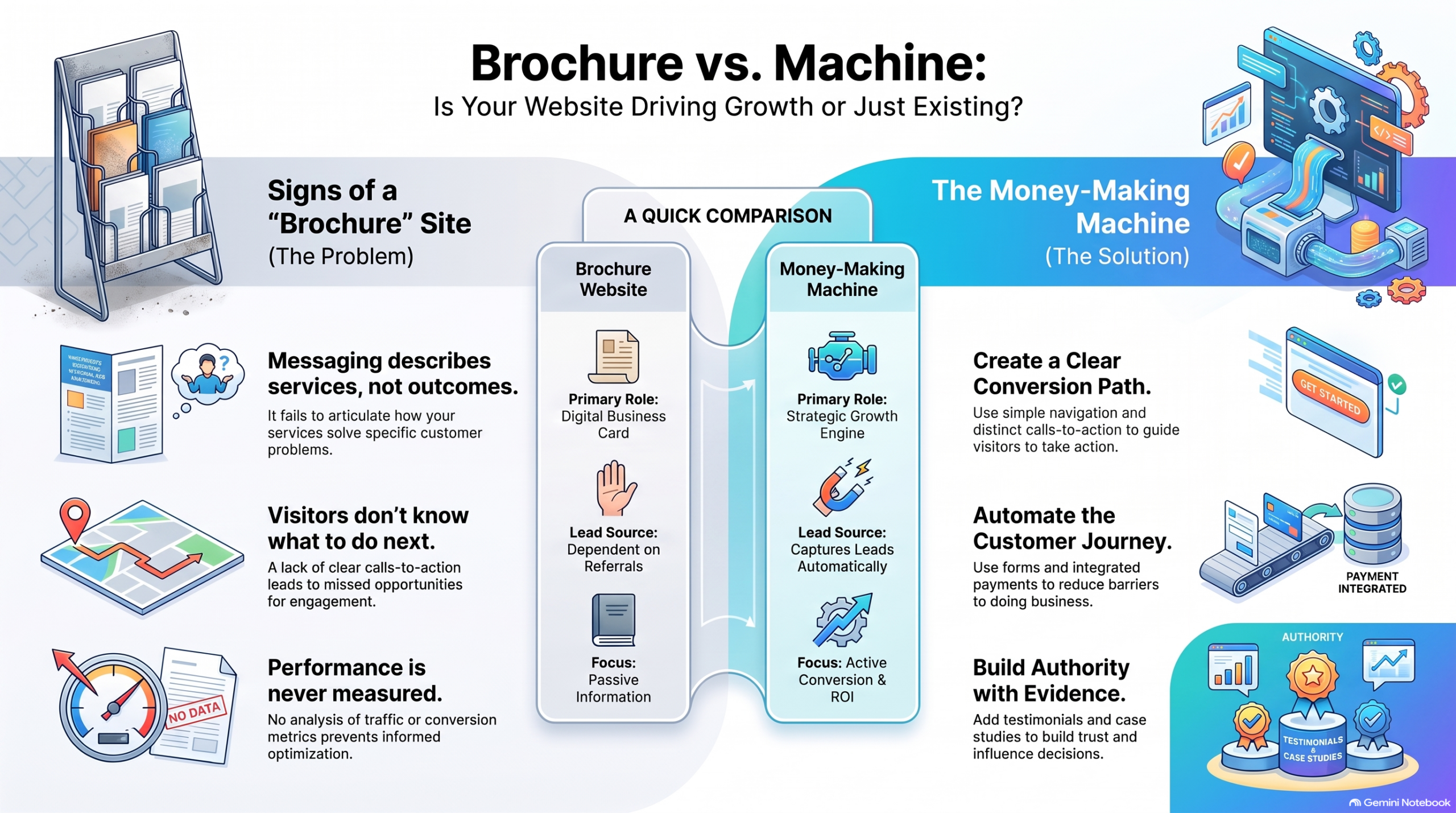
1. Having a website isn’t enough
Many service-based businesses treat their website as a digital business card, believing that simply having a web presence is sufficient to attract customers. This often leads to a lack of engagement and conversion opportunities because the site fails to communicate the unique value the business offers.
Simply being online doesn’t mean the website contributes to revenue; many sites lack the strategic elements needed to convert visitors into clients, such as clear calls to action or compelling content that resonates with the target audience.
What does your website actually do for your business?
Does your site merely provide information or does it actively drive growth, engagement, and fresh leads in a way that supports your business goals?
2. The hidden cost of a passive website
Prospective clients visit but often leave without a clear understanding of the unique value the business provides, which can diminish their interest and likelihood of engagement.
Qualified leads may leave the site without taking any action due to a lack of compelling calls-to-action or engaging content, leading to missed opportunities for conversion.
Business owners often find themselves remaining dependent on referrals and manual sales efforts, which can be unsustainable and limit growth, as they are not capturing online opportunities efficiently.
Wasting time and money on a website that yields no return only leads to frustration and stagnant growth.
3. Why business owners accept underperforming websites
They believe having any website checks the necessary box, failing to recognize that an effective website requires ongoing strategy and refinement to truly serve its purpose.
They don’t know what a conversion-focused website can accomplish, overlooking how such a site can engage users, drive sales, and provide valuable insights through analytics.
The website hasn’t been updated as the business or market has changed, which may result in outdated information, loss of relevance, and missed opportunities to connect with current trends.
Web-development jargon obscures the outcomes that matter, making it difficult for business owners to understand the essential elements that contribute to a website’s effectiveness in generating leads and conversions.
4. What a money-making website actually does
Effectively communicates the company’s value clearly, ensuring that visitors immediately understand what sets the business apart from competitors and why they should choose its services.
Educates potential customers by providing valuable information and insights, guiding them through their decision-making process to build trust and establish authority in the industry.
Separates serious prospects from casual browsers by identifying and engaging target audiences through tailored content and strategic messaging, allowing for more effective lead nurturing and conversion strategies.
Captures leads, books appointments, or accepts payments through user-friendly forms and integrated payment solutions, streamlining the customer journey and reducing barriers to engaging with the business.
Automates parts of the customer journey, such as follow-up emails and reminders, to enhance customer experience and maintain engagement without requiring constant manual intervention.
5. The “do nothing” test
Consider these critical questions:
What happens if the website stays the same? Evaluate whether stagnation leads to lost potential customers and missed growth opportunities.
How much time, revenue, or opportunity is being lost? Reflect on the cumulative effects of inactivity on your business’s bottom line and overall success.
Is the website creating momentum—or merely existing? Assess if your online presence drives meaningful interaction and fosters long-term relationships with clients.
6. Five signs your website is still just a brochure
Visitors don’t know what to do next, often landing on the homepage without clear navigation or prompts that guide them toward taking meaningful actions, such as signing up for a newsletter or making a purchase.
The messaging describes services but not customer outcomes, failing to articulate how those services solve specific problems or add value to potential clients’ lives.
Leads rarely come through the site, indicating a lack of effective calls-to-action and engagement strategies that encourage visitors to submit inquiries or take the next step in the buying process.
Content is outdated, leaving visitors with information that may no longer be relevant, reducing the site’s credibility and failing to reflect current industry standards or offerings.
Performance isn’t measured, which means there is no analysis of web traffic, user behaviors, or conversion metrics, preventing business owners from making informed decisions to optimize their online presence.
7. Turning the website into a business asset
To truly make your website work for your business, you must first understand exactly who you are trying to reach and the specific challenges they face. When you can clearly articulate their urgent problem, your website immediately shifts from a static brochure into a valuable resource.
Replace technical language with customer-friendly terminology to ensure that potential clients easily understand your offerings and feel more connected to your message; instead of using industry jargon, explain concepts in relatable terms.
Create a clear conversion path that visually and logically guides visitors from initial interest to taking action; utilize simple navigation, distinct calls to action, and a structured layout to facilitate their journey toward making a purchase or inquiry.
Add evidence, such as customer testimonials, case studies, and statistics, to build trust and credibility; showcasing real experiences and outcomes can significantly influence prospects’ decisions to choose your services over competitors.
Measure results and continuously improve by analyzing website data regarding visitor interactions, conversion rates, and user feedback; regularly assess this data to identify areas for enhancement, ensuring your website evolves in response to both business goals and customer needs.
8. Conclusion
A website’s value depends on how intentionally it is used, as a strategic approach can transform a passive online presence into a powerful tool that drives engagement and revenue.
Does your site generate business or merely display information? Conducting a thorough analysis of visitor interactions, conversion rates, and available analytics will help you to identify areas of improvement.
Request a website review or strategy consultation to gain insights into potential enhancements and develop a customized plan that aligns the website’s capabilities with business objectives.
This post was created with the assistance of Wispr Flow and a conversation with Dadrene Cisse of Green Phoenix
FAQs: Is Your Website Just a Brochure—or a Money-Making Machine?
1. How do I know if my website is a brochure or a money-making machine?
Apply the “do nothing” test. If nothing about your site changed for the next twelve months, would you lose anything measurable? A brochure site describes your services, looks reasonably current, and quietly costs you opportunities. A money-making site does five jobs: it communicates your value clearly, educates prospects, separates serious buyers from casual browsers, captures leads or books appointments, and automates part of the follow-up.
Five quick warning signs you are still running a brochure:
- Visitors land and don’t know what to do next
- Messaging describes your services rather than customer outcomes
- Leads rarely arrive through the site
- Content is out of date
- Performance isn’t measured at all
If three or more apply, the site is decoration, not infrastructure.
2. My referrals keep me busy. Why should I invest in the website at all?
Because referral-only growth caps what you can build and leaves you doing sales manually, one conversation at a time. A passive site keeps that dependency in place: qualified prospects visit, don’t see the value clearly stated, and leave without acting. You never see the loss, which is exactly why it continues.
A conversion-focused site does the early qualifying work before you ever get on a call, so your time goes to prospects who are already informed and interested. It also gives you data — traffic, behaviour, conversion rates — so decisions stop being guesswork. Referrals become one channel instead of the only one.
3. What should I fix first, and do I need a full redesign?
Usually no redesign is required. Most underperforming sites fail on message and path, not appearance. Work in this order:
- Name the audience and the urgent problem you solve, in their words
- Replace jargon with plain customer-friendly language
- Build one clear conversion path — simple navigation, an obvious next step, a single primary call to action per page
- Add evidence: testimonials, case studies, real outcomes
- Turn on measurement, then improve based on what the data shows
Steps one through three can often be done with existing pages and existing content. Redesign only after you know what the site is supposed to accomplish, otherwise you are paying to rebuild the same brochure with better fonts.