What an under-attended Red Deer event may reveal about local hiring confidence, recruitment habits, and employer priorities.
Is the job market really that soft, or is it just that recruiting has moved online? The reason I ask this question is that I had the opportunity today to accompany my wife Amee to a career fair that was promoted on Facebook. We went to attend and were shocked at the absence of exhibitors, the absence of employers. The place was probably 75% empty, and I think I’m being generous. There are only 11 exhibitors:
- one from the Canadian Army
- one from the Canadian Air Force
- another from the Calgary Police Service
There were two oil field drilling companies with booths, which I would have expected. However, there were more employers from out of town than there were from in town.
So I guess my question still stands: is the market so unpredictable and tight that employers aren’t being proactive to try to build their brand and attract talent, or has all that moved online?
There’s no question that there’s a huge online presence for human resource recruiting on sites like LinkedIn and Indeed, amongst others. However, it makes you wonder: if established companies and organizations like the city of Red Deer didn’t think it was worthwhile, what does that say?
It’s very interesting to me that the City of Red Deer, the province of Alberta, and the government of Canada were not present at the Career Fair.
Obviously, the Canadian government is going through some right-sizing that we can see on the news. What’s going on with the employers in town? Is it a lack of vision? Have they lost confidence in the economy, or are their profit margins so tight that they can’t afford any expenditure that isn’t directly linked to producing revenue?
Was this event a failure because of the promoter not doing their job, or is it a reflection of the economy and what’s going on?
Perplexity Synopsis
I asked Perplexity for a synopsis of Canadian employment trends, and here is the answer:
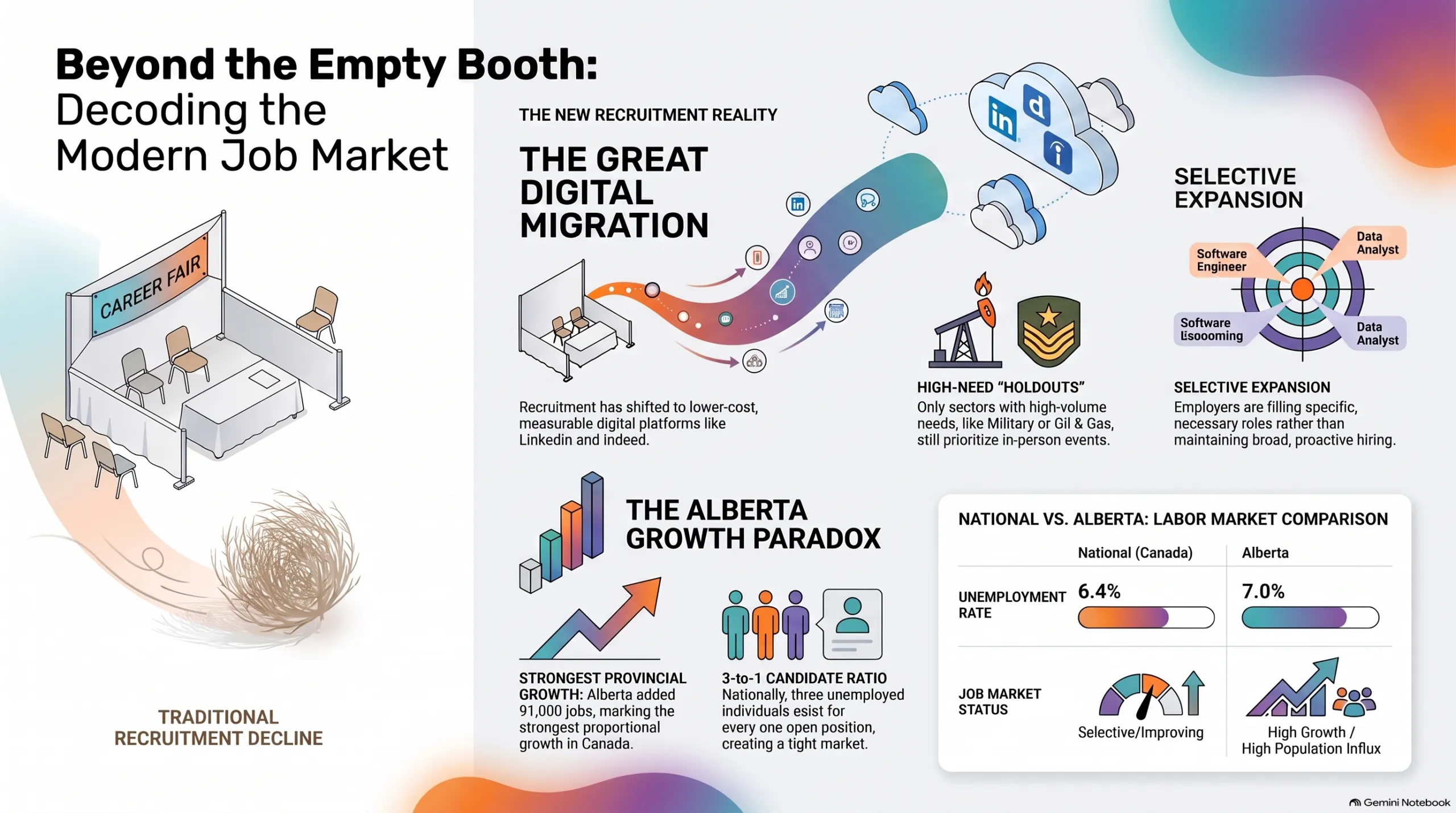
Canada’s hiring market is improving, but it remains selective rather than broadly expansionary. National employment rose by 75,000 in July 2026 and unemployment fell to 6.4%, but job vacancies have stayed roughly flat for several months, with about three unemployed people for every open position. That suggests employers are filling necessary roles and seeking specific skills, while remaining cautious about overall headcount. www150.statcan.gc
Demand appears strongest in construction, professional and technical services, finance-related work, health and social assistance, and certain specialized professional roles. Alberta has added jobs faster than most provinces year over year, yet its unemployment rate remains 7.0% because its labour force and population are also growing quickly. In other words, more people are looking for work even as jobs are being created. jobbank.gc
Your nearly empty Red Deer career fair is not, by itself, proof that the local economy is failing or that employers have stopped hiring. It likely reflects a shift toward lower-cost, more measurable recruiting through LinkedIn, Indeed, referrals, internal talent pools, and direct outreach—combined with tighter budgets and more cautious hiring decisions. Employers facing high-volume or hard-to-fill recruitment needs, such as military, policing, drilling, and health care, have more reason to show up in person; many local businesses may only recruit when a specific role is open rather than investing in ongoing employer-brand visibility.
Alberta Employment Trends
Alberta is a particularly useful example of why people can experience the market as tight even while employment grows.
What’s not mentioned in this synopsis is that Alberta, as a province, added 91,000 jobs, which was the strongest proportional growth amongst the provinces of Canada. However, its unemployment rate was still 7%, whereas the national average is 6.4%.
Further commentary from Perplexity.
The evidence points less to “there are no jobs” and more to a selective, cost-conscious, digitally mediated hiring market. A poorly attended event may reflect both organizer execution and employer caution—but the broader data do not support a simple claim that hiring across Canada or Alberta has collapsed.